ISO 14726
Identification colours for the content of piping systems
Marine pipe marking identifies the services carried through a vessel's pipework, distinguishing lines that otherwise look alike as they run through an engine room or service passage.
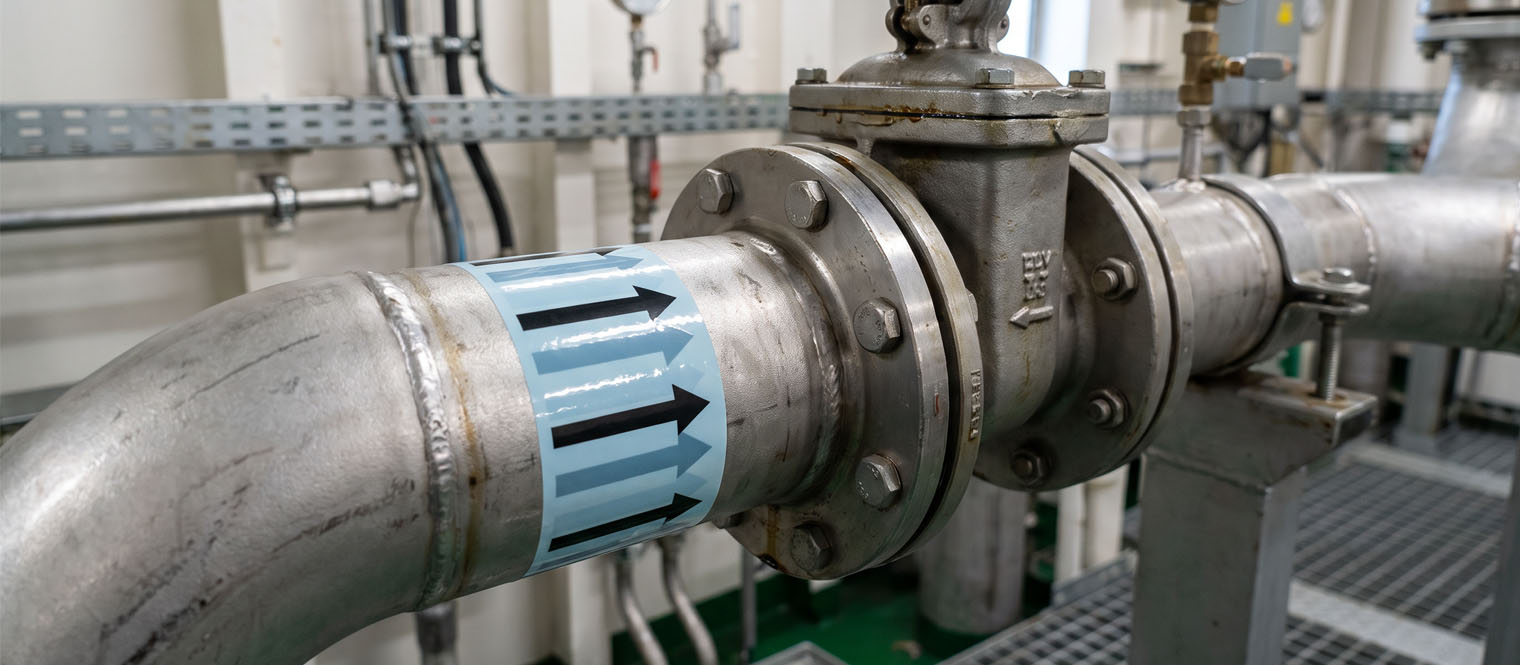
Water, fuel, air and other services can follow the same route before separating towards different equipment. Marking gives each line an identity along that route.
Pipe identification tape provides the colour marking, while a separate flow direction tape indicates direction where the vessel's arrangement requires it. Both need to be consistent with the pipe schedule and drawings used aboard the ship.
Branches, bulkhead passages and insulated runs are places where visual continuity can be lost. A marker near an accessible valve or connection provides a reference without requiring the entire line to be traced.
Viewing position matters too. A label readable from a machinery platform may face away from a person on the walkway below. The marking needs to be visible from the place where the line is normally identified or operated.
The outside diameter, including any insulation, decides how much tape each band takes and how it wraps. The surface and its surroundings affect where the marking will hold and stay readable.
Permanent pipe identification should remain distinct from temporary maintenance tags. One names the service; the other communicates an instruction applying to a particular item or job.
Standards
ISO 14726 gives the identification colours for the content of piping systems aboard ship. Marine pipe marking works by colour code rather than by the information labels used ashore, so it is specified differently from ISO 20560 pipe marking and the two are not interchangeable.
Identification colours for the content of piping systems
Self-adhesive pipe marking tape in twelve colours, plus a flow direction tape, all 50 mm wide and supplied in 30 m rolls. The colours are the identification colours; the flow tape carries the directional arrows.
ISO 14726, which sets the colour identification system for pipes on ships. It is the maritime system and it is not the same as the shore-side one: our pipe marking for industry follows ISO 20560, and the two must not be mixed in one specification.
At the points where a line is normally identified or operated, and where visual continuity would otherwise be lost — branches, bulkhead passages, insulated runs, and near accessible valves and connections. A marker there saves tracing the whole line. Viewing position matters too: a band readable from a machinery platform may face away from someone on the walkway below.
Not in this range. What DENFOIL supplies here is the colour identification tape and the flow direction tape. Where a vessel's arrangement also calls for the service name in text, a distributor can say what is possible.
No. DENFOIL is supplied through distributors, who quote the specification and handle the order.
Tell us which services the lines carry, the outside diameters including insulation, and where the marking is read from. A distributor quotes the specification.