IMO A.1116(30)
Escape route signs and equipment location markings
Emergency equipment signs identify where help and emergency supplies can be found aboard ship, including equipment stored behind a closed door.
A first aid sign identifies a cabinet or treatment point among the other doors and fittings in an accommodation area. Stretcher and medical equipment signs identify storage positions that may be unfamiliar to joining crew or visiting personnel.
Where equipment is out of sight from the corridor, a direction sign can point towards it. Identification at the cabinet then confirms the destination.
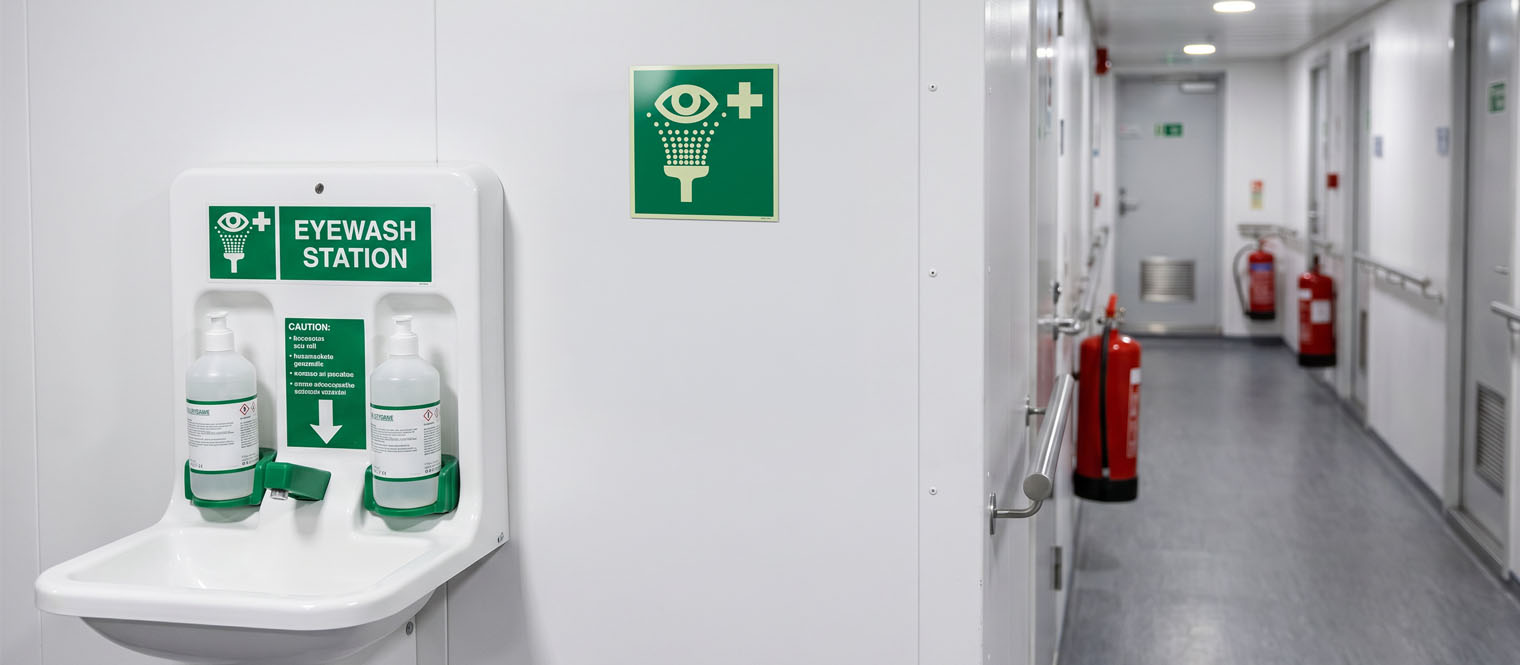
In workshops and technical areas, emergency showers, eyewash stations and emergency communication points need an identity that relates to the equipment actually present.
A generic equipment notice provides less information than a message naming the function. Someone looking for an eyewash station needs to distinguish it from a first aid cupboard or a nearby safety locker without opening each one.
Position matters where equipment sits in a recess, behind an open door or among similar lockers. The sign belongs where it can be read from the normal approach, with an unambiguous connection to the equipment.
The equipment names used on signs should also be familiar from onboard briefings. When a crew member hears where a stretcher or first aid kit is kept, the same name at the location completes the instruction.
Standards
IMO Resolution A.1116(30) sets out escape route signs and equipment location markings. It applies to ships built from 1 January 2019, and to ships under repair, alteration or outfitting from that date, under SOLAS chapters II-2 and III. ISO 24409-1 covers how shipboard signs are designed; ISO 24409-3 covers where they belong and how they are used together.
Escape route signs and equipment location markings
Design principles for shipboard safety signs, fire control plan signs, safety notices and safety markings
Code of practice: where signs belong on board and how they are used together
Signs identifying first aid and medical equipment, stretchers, emergency eyewash and the other emergency provisions kept in accommodation and working spaces, together with the direction signs that lead to them. Signs for survival equipment such as lifejackets, lifebuoys and liferafts are Life-Saving System.
ISO 24409-1 covers how the sign is designed and ISO 24409-3 covers where it belongs. IMO Res. A.1116(30) covers escape route signs and equipment location markings, which is why it applies here as well as to escape marking.
That depends on whether the equipment can be seen from the normal approach. Where it sits in a recess, behind an open door or among similar lockers, a direction sign answers where to go and the sign at the cabinet confirms arrival. The two answer different questions and are often both needed.
It is worth making it match. When a crew member is told during familiarisation where a stretcher or first aid kit is kept, the same name at the location completes the instruction; a different name at the door leaves the person checking.
No. DENFOIL is supplied through distributors, who quote the specification and handle the order.
Extinguishers, hose cabinets, fire blankets and equipment lockers.
View categoryTell us which equipment is installed and where it sits relative to the approach. A distributor quotes the specification.