IMO A.760(18) as amended by MSC.82(70)
Symbols related to life-saving appliances and arrangements
Life-saving signs identify survival equipment and the places where it is stored or used aboard a vessel, both for regular crew and for people unfamiliar with the ship.
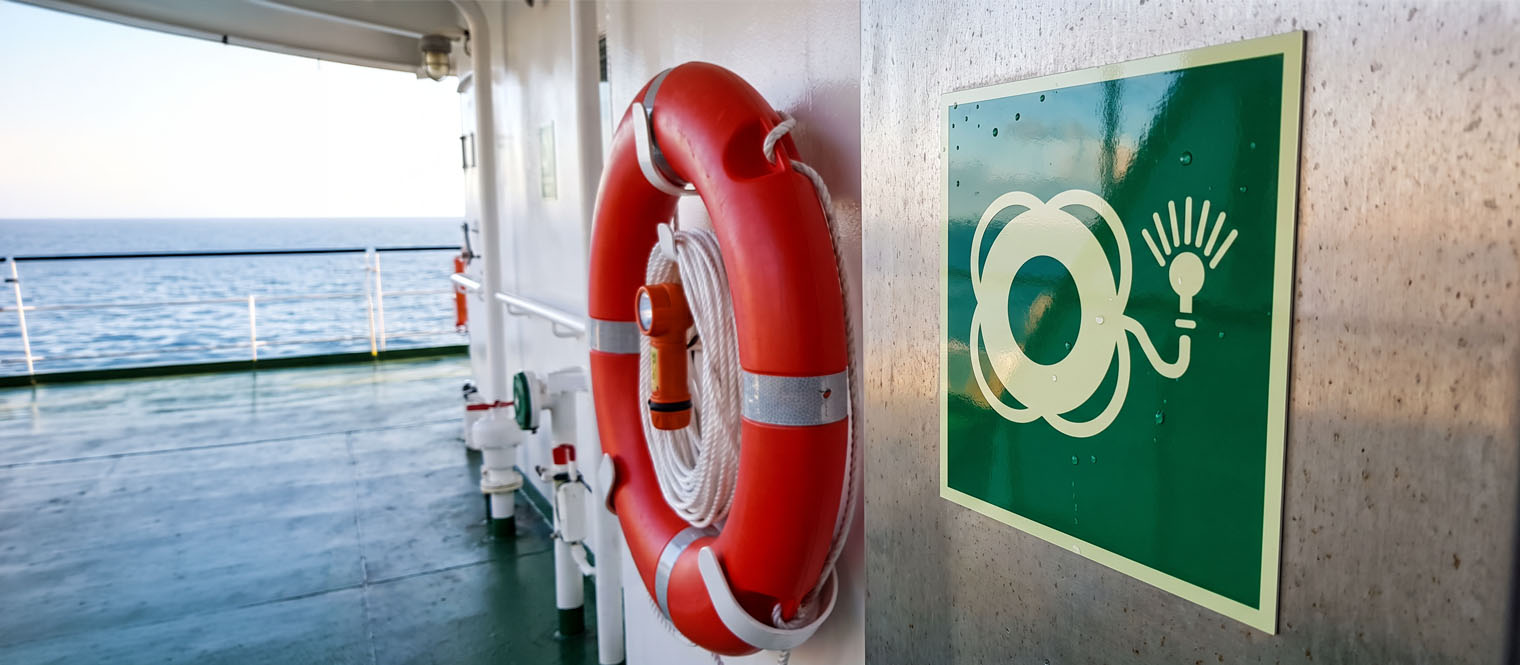
Boat decks can contain several similar stations. Equipment names and station identifiers distinguish the intended location, especially where positions are repeated on opposite sides of the vessel.
A marker at the boat or raft confirms arrival. Directional information along the approach helps people reach that position from the spaces they occupy. The station name used in a briefing should be the same name encountered on deck.
Lifejacket signs identify storage behind locker doors. Lifebuoy signs mark positions along the deck, while other life-saving equipment markers identify the relevant stowage point or appliance.
The equipment type matters. A sign naming a liferaft gives more useful information than a general safety notice when someone needs that particular destination.
Life-saving identification works with the escape and assembly information aboard the vessel. Route signs show where to go; equipment and station markers identify what is there.
That connection is particularly important after changes to stowage or embarkation arrangements. A route can still lead to the right part of the deck while an old station name points to the wrong position. Consistent equipment names and identifiers give the vessel's physical arrangement a clear counterpart in crew familiarisation.
Standards
IMO Resolution A.760(18), as amended by MSC.82(70), gives the symbols for life-saving appliances and arrangements. A.1116(30) covers escape route signs and equipment location markings and applies to ships built from 1 January 2019, and to ships under repair, alteration or outfitting from that date. ISO 24409-1 covers how shipboard signs are designed.
Symbols related to life-saving appliances and arrangements
Escape route signs and equipment location markings
Design principles for shipboard safety signs, fire control plan signs, safety notices and safety markings
Identification for survival equipment and its stowage: lifeboats and liferafts, lifejackets — including lifejackets stowed under seats — lifebuoys, lifebuoys with line and with light, and the other life-saving appliances kept about the vessel.
The symbols come from IMO Res. A.760(18) as amended by MSC.82(70), which is the symbol source for life-saving appliances and arrangements; the amendment matters, because the 1993 symbol set on its own is incomplete. IMO Res. A.1116(30) covers equipment location marking, and ISO 24409-1 covers how the sign itself is designed.
Yes. It was not replaced by A.1116(30) — A.1116(30) refers to it. A reference to A.760(18) should always be written as amended by MSC.82(70).
The names have to be brought back into agreement. A route can still lead to the right part of the deck while an old station name points to the wrong position, which is the failure worth looking for after a refit. The name used in familiarisation and the name on deck should be the same one.
No. DENFOIL is supplied through distributors, who quote the specification and handle the order.
Tell us which appliances are carried and how the stations are named on board. A distributor quotes the specification.