Security notices and access information for vessels
Ship security notices, labels and indicators communicate boarding and access arrangements, from the gangway to the controlled spaces inside.
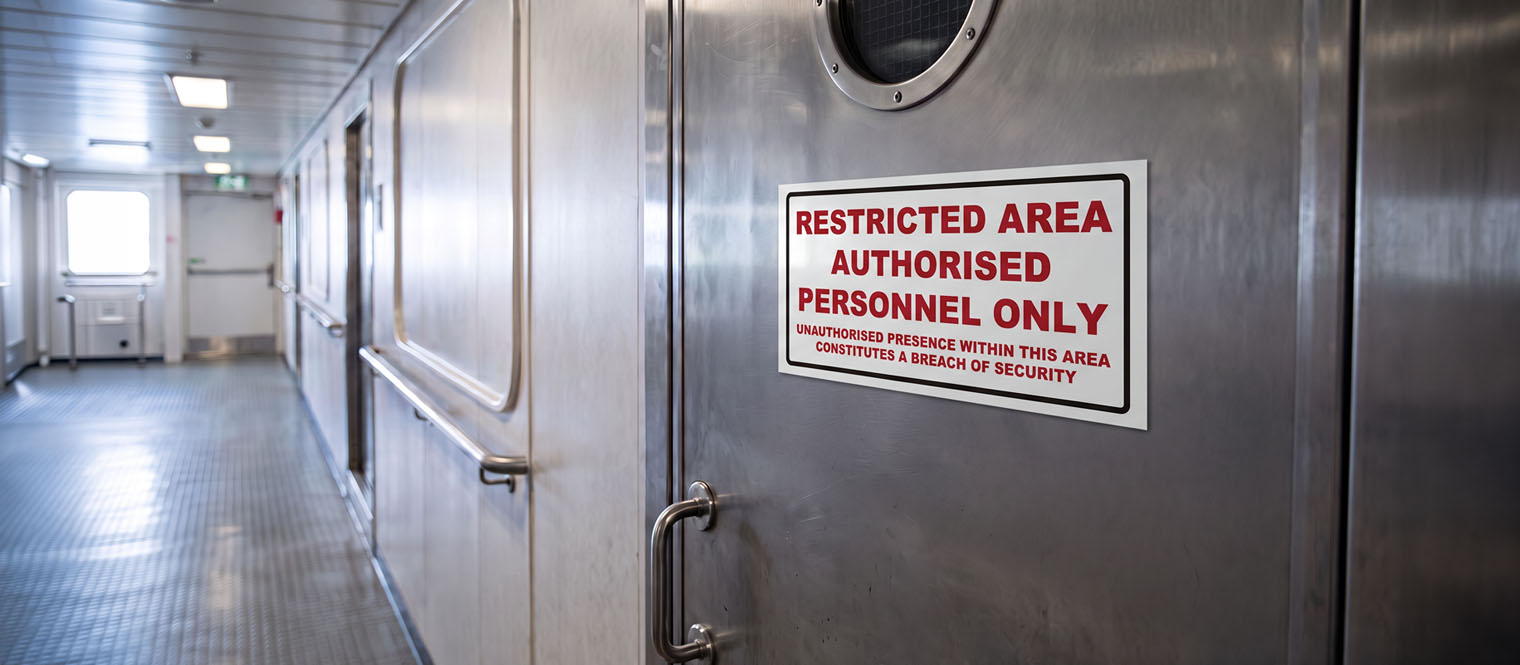
Gangway notices and visitor reporting
From the quay to the receiving crew member, the information needs to follow the visitor's route.
The gangway is often the first point where a visitor encounters the vessel's instructions. A boarding notice can identify the reporting arrangement before the person reaches the deck.
The destination needs a recognisable name. If the notice refers to a security office or reception point, that location should use the same wording. This avoids leaving someone with an instruction but no clear place to follow it.
Access labels and security indicators
Internal labels communicate the arrangement for controlled rooms and stores. Lock-status labels and security indicators convey specific information at the location where it is used.
These messages need to remain consistent with the current access arrangement. An indicator describes the displayed status; a room name identifies the destination. Both may be present at the same door, with distinct purposes.
Information suited to the reader
Visitors may need boarding and reporting instructions, while crew need more specific information about access to a space. Clear wording keeps each message relevant to its audience.
Security notices can appear alongside restricted-entry signs, room identification and local instructions. Their relationship should be clear: what the space is, who may enter it, and which action applies before entry.
What to tell us about the arrangement
- Where the message belongs on the visitor's route, from the quay to the receiving crew member.
- The name of the reporting point, exactly as it is used elsewhere on board.
- Whether the message is for visitors or for crew, since the two need different information.
- The size and the distance it is read from, and whether it goes outdoors at the gangway.
- The language, and any wording that has to agree with the vessel's own security arrangement.
Security signs, answered
What does the range cover?
Gangway and boarding notices, visitor reporting instructions, and the access labels and security indicators used at controlled rooms and stores on board.
Why does the destination name matter so much?
Because a reporting instruction without a findable destination leaves the visitor stranded. If a boarding notice refers to a security office or reception point, that location has to use the same wording; otherwise someone arrives with an instruction and nowhere to follow it.
Which standards apply to security signs?
Shipboard security arrangements are governed by the ISPS Code, and what these messages have above all to match is the vessel's own security arrangement under it. That is why they are specified against the arrangement rather than picked from a catalogue. For the safety signs elsewhere in this range, the governing design standard is ISO 24409-1.
How do security signs sit alongside the other signs at a door?
They answer different questions, and often appear together: what the space is, who may enter it, and which action applies before entry. A room name identifies the destination, a restricted-entry sign states who may enter, and a lock-status indicator describes the displayed status. Keeping the three distinct is what makes the door readable.
Can DENFOIL be bought directly?
No. DENFOIL is supplied through distributors, who quote the specification and handle the order.
Specifying security notices for a vessel
Tell us the boarding arrangement and which spaces are controlled. A distributor quotes the specification.